If you’ve landed here, it’s probably because you want to improve the results of your advertising campaigns on Facebook Ads.
Rest assured, you’re in the right place!
As an agency specializing in Social Ads, we work with a multitude of clients from various sectors, so we’ll share our best advice and expertise with you.
In this article, our Head of Performance, Many, reveals all his tips for creating effective Facebook Ads campaigns that convert.
What is a Facebook Ads campaign?
Before getting to the heart of the matter, let’s briefly recall how advertising on Facebook Ads works.
To launch an advertising campaign on Facebook Ads, you must use Facebook Business Manager.
This Meta ad manager allows you to run ads on both Instagram and Facebook.
Note: Although it is possible to boost your posts directly from the apps, we strongly advise against this approach.
A Facebook Ads campaign is structured on three distinct levels:
- The campaign (where you choose your brand’s objectives)
- Ad sets (where you set the budget, targeting and ad placements)
- Ads (including videos, images or carousels)
It is crucial to clearly define your objectives before launching any campaign on Facebook Ads.
Which objectives are available for my Facebook Ads campaign?
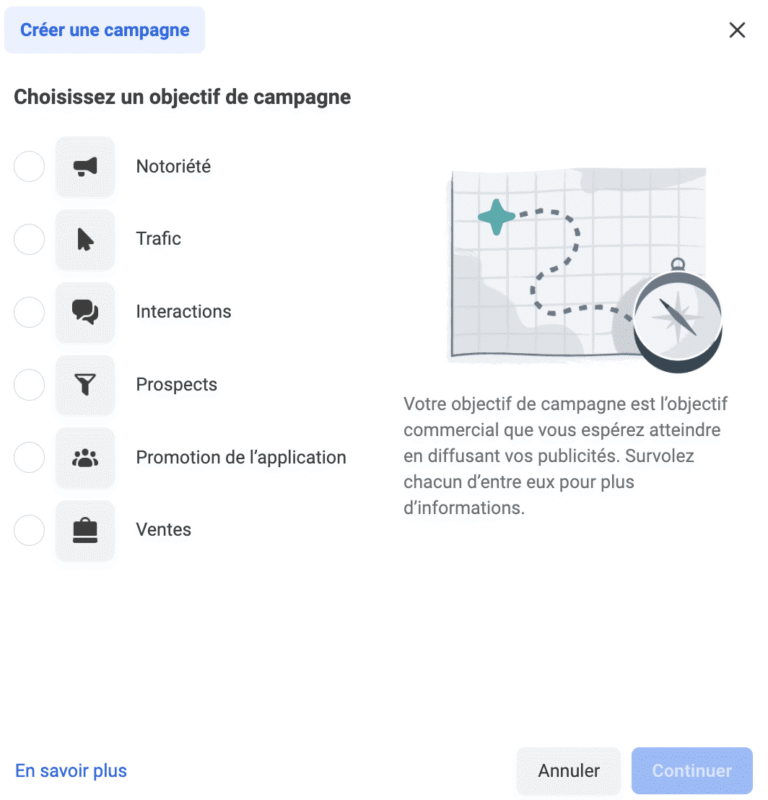
On Facebook Ads, you can choose from six campaign objectives to meet your brand’s specific needs:
- Awareness: This campaign aims to show your ads to a wide audience to increase your brand’s visibility
- Traffic: This campaign makes it possible to drive traffic to your website or app
- Engagement: This campaign aims to encourage engagement with your ad, including actions such as likes and comments
- Leads: This campaign is designed for lead generation, notably through instant forms to obtain qualified leads.
- App promotion: This campaign promotes your app and directs consumers to app stores to download it
- Sales: Also called a conversion campaign, this approach is widely used by most advertisers to maximize their sales
The essential technical setup for your Facebook Ads campaign
1) Check that the Pixel and its events are installed correctly
Before launching anything on Facebook Ads, you must make sure that the Meta Pixel is properly installed on your website.
The Facebook Pixel is a piece of code to implement on your site.
It plays a crucial role in analyzing and reporting users’ actions after they interact with your ads.
These actions include, among others:
- Add-to-carts
- Purchases
- Page views
- Cart abandonments
The Pixel is of paramount importance for tracking users’ actions and optimizing your advertising campaigns accordingly.
It’s also thanks to the Pixel that you’ll be able to retarget your visitors, create lookalike audiences or track cross-device conversions.
Carefully check that all events related to your site are correctly reported by the Pixel, such as add-to-carts and purchases.
Watch out for event deduplication issues, which can distort data by causing duplicate conversions.
Tip: To make this check easier, you can use the “Meta Pixel Helper” Chrome extension.

This extension lets you check that the Pixel is installed correctly, identify any errors and get guidance on how to fix them.
This extension also makes it possible to test that all events are being reported.
Here’s an example with our client Pin Up Secret after an add-to-cart.
We can see that 3 events are correctly reported:
- Page view
- Add to cart
- Product page view
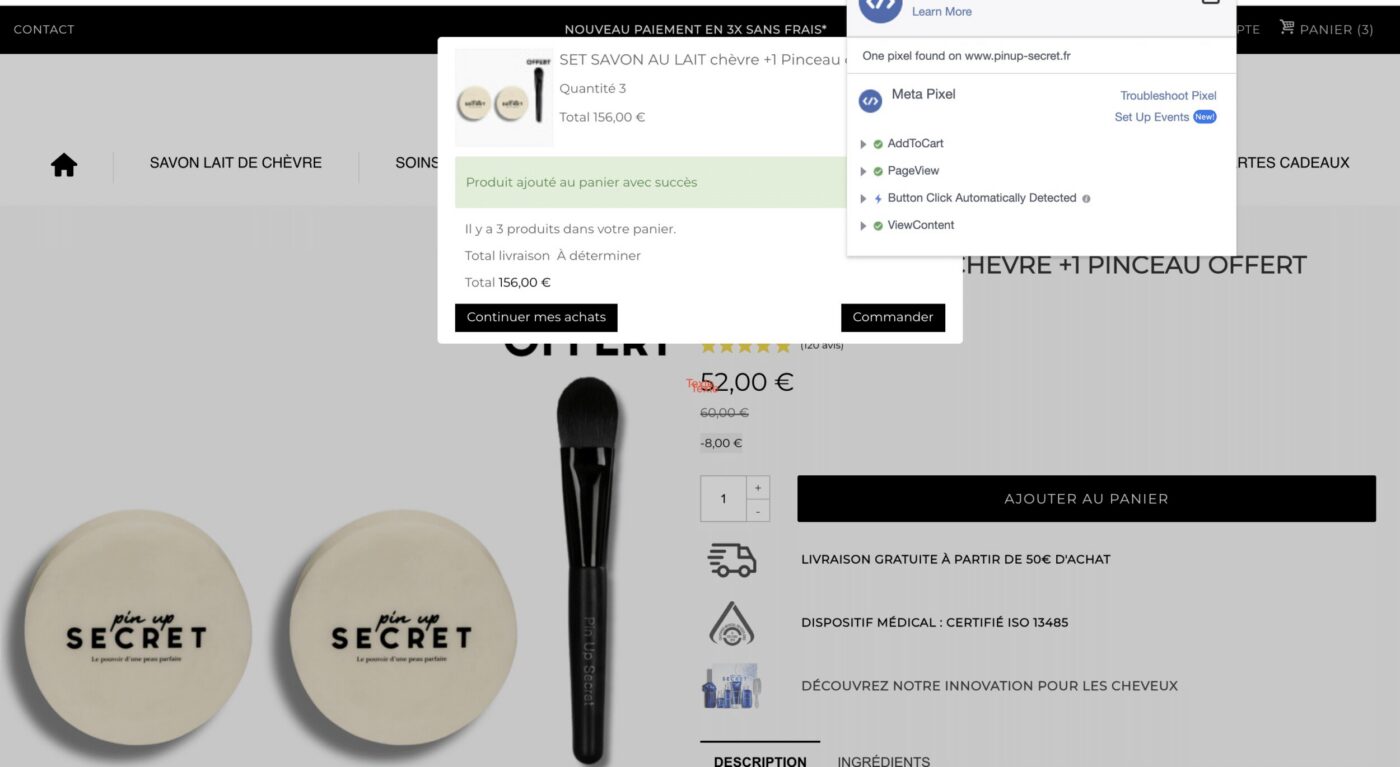
To finish with the Pixel, don’t forget to check that all variables are correctly reported to the Pixel, such as product IDs, values, product prices, quantities, and customers’ phone numbers and email addresses.
2) Check that the Conversions API works properly
The Conversions API complements the Pixel and is ultimately intended to replace it.
Indeed, the Conversions API makes it possible to report much more precise and reliable data than the Pixel, which helps further improve the performance of your advertising campaigns.
The Pixel works using cookies, which are currently disappearing and which sometimes don’t report all data exhaustively
Unlike the Pixel, which depends on cookies, the Conversions API uses a server-to-server system, ensuring data is reported perfectly to Facebook Business Manager without going through an intermediary.
Tip: More and more CMSs, including Shopify, make it easy to integrate the Conversions API in a few clicks.
Many’s hacks : In addition to the Pixel and the Conversions API, don’t hesitate to check that your product catalog feed is working properly before sending it to Facebook Ads Manager.
Defining the audiences for your Facebook Ads campaign
3) Set up hot and warm audiences
If you haven’t built audiences on Facebook Ads yet, it is imperative to create hot and warm audiences for your mid- and bottom-of-funnel retargeting campaigns.
Warm audiences include consumers who have already shown some level of engagement with your brand.
You can therefore create an audience segment for:
- Interactions on Facebook and Instagram
- Website visitors
As for hot audiences, they correspond to people with a high purchase intent towards your brand, or existing customers.
You can create the following audience segments:
- Add-to-carts and cart abandonments
- Opt-ins from your newsletter base
For manual audiences, such as adding your customer database, make sure you update them regularly.
It is crucial to stress that a proper Pixel installation is required to generate most of these audiences, as explained above.
4) Create lookalike audiences
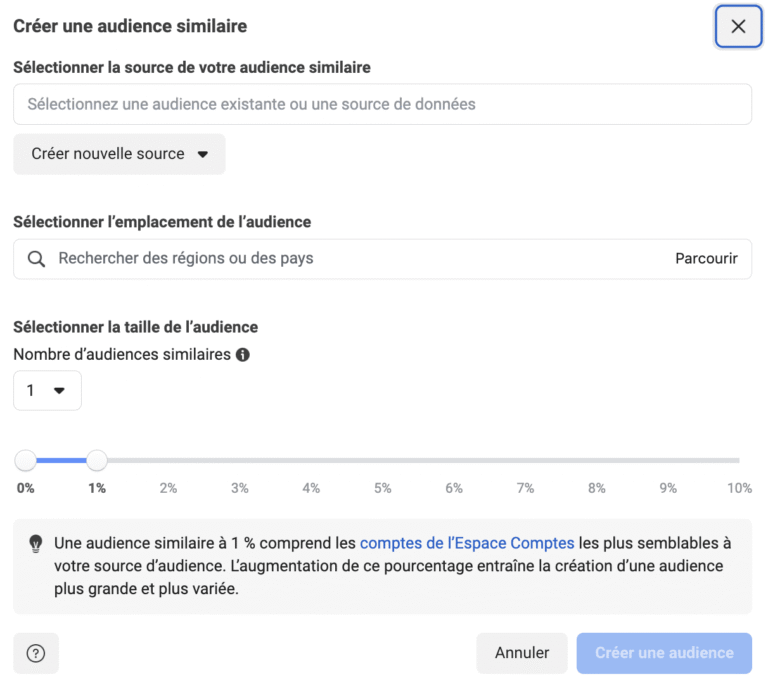
One of the great strengths of advertising on Facebook Ads is the ability to create similar or “lookalike” audiences from existing data or samples.
So why deprive your campaigns of them?
One of the most effective methods, adopted by many advertisers, is to create lookalike audiences based on purchasers via the Pixel, or on your existing customers.
As for the size of the lookalike audience, our experts recommend a size that is neither too large nor too small.
Many’s hacks: Pay particular attention to audience overlap to prevent some ad sets from competing with each other.
Account structure and strategy
5) Organize your structure according to the sales funnel
To get high-performing Facebook Ads campaigns, you need to structure your campaigns according to your sales funnel, dividing potential customers according to their purchase intent.
TOF campaigns (Top of Funnel), at the top of the sales funnel, target consumers who are not yet familiar with your brand.
MOF campaigns (Middle of Funnel), in the middle of the sales funnel, target consumers who have shown some interest in the brand without taking action.
As for BOF campaigns (Bottom of Funnel), at the bottom of the conversion funnel, they target consumers with high purchase intent or who are already customers of the brand.
For all these campaigns, it is essential that your targeting and audiences differ.
Don’t hesitate to use audience exclusions when necessary to ensure relevant and effective segmentation.
6) CBO or ABO?
A question advertisers often ask is whether to choose ABO or CBO.
Before answering, let’s explain what they are.
ABO (Ad Set Budget Optimization) means optimizing the budget at ad set level, where you assign specific budgets to each ad set to optimize them against one another.
This gives you direct, total control over spending and lets you evaluate the performance of each ad set individually.
CBO (Campaign Budget Optimization), on the other hand, gives Facebook the power to decide which ad set gets more or less budget.
Generally, the ad set that gets the best results will receive a larger budget.
Our recommendation is to favor CBO when you have large campaigns with sizable audiences, letting the algorithm determine the best-performing ad sets.
On the other hand, opt for ABO only if you have a smaller account, giving each ad set its chance and determining what really works.
7) Optimize your budget properly
As for budget, although Facebook doesn’t impose a specific daily amount, we recommend a minimum budget of €50 per day to exit the learning phase faster.
However, it is essential to adjust your budget according to the level of purchase intent.
Allocate a major share of your budget to the Top of Funnel (TOF), while strengthening retargeting to create repetition.
The statistic: According to a study by Kantar Worldpanel, a viewer needs to see a TV ad more than 10 times before buying, and this logic also applies to social media advertising.
Many’s hacks: Trust the algorithm and favor lookalike audiences over interest-based audiences.
Bet on broad audiences and only include the basic parameters (location, age, gender).
For ad sets, use between 3 and 5 ads per ad set.
Creativity at the heart of Facebook Ads campaigns
8) Adapt your message
To craft impactful messages and drive conversion, it is imperative to adapt the content of your advertising campaigns.
On Facebook, a large share of consumers are not yet familiar with your brand.
It is therefore inappropriate to show new consumers the same visuals as established customers.
It is essential to adjust to the level of engagement of each target group.
- At the top of the sales funnel, focus on introducing and discovering the brand
- In the middle of the sales funnel, highlight new products and best-sellers to keep prospects interested
- At the bottom of the sales funnel, favor promotional offers and strengthen reassurance factors such as free delivery and returns to encourage conversion
This segmented approach optimizes the impact of your messages by taking into account how familiar and engaged the targeted audiences are at the different stages of the buying process.
9) Vary your ad formats
According to a Nielsen study reported by Facebook, 56% of a campaign’s sales ROI comes from the quality of the creatives.
It is therefore imperative to test and, above all, diversify your ads using the available ad formats.
Although video remains the best-performing format, many other formats are also effective, such as images, carousels, DPA (Dynamic Product Ads) and Collection Ads for retargeting.
We learn by experimenting, and it is also through these tests that we understand what our target audience expects.
Don’t hesitate to run A/B tests by varying angles, descriptions and calls to action (CTAs).
A crucial point to consider is the need to refresh your creatives regularly to avoid ad fatigue.
Ad fatigue occurs when your audience stops being receptive to your message and gets tired of your ad, which has a direct impact on completion rates, engagement and, of course, conversions.
Here you can find all the ad formats available on Instagram Ads.
10) Use UGC to boost your sales
As the leading UGC content creation agency in France, we can tell you there’s a real difference in performance between traditional ads and ads that include UGC videos.
Today, the way consumers perceive brands has changed.
They now look for authenticity and credibility from companies.
User Generated Content offers internet users a more natural and credible experience.
In this context, it’s no longer brands that do all the talking, but consumers themselves.
Indeed, a HubSpot statistic shows that 92% of customers trust content shared by a third party more than content published directly by a brand.
This trend highlights the growing importance of UGC in creating authentic and engaging connections with audiences.
In addition, producing UGC content costs considerably less than a shoot or a traditional ad.
It’s a format accessible to everyone, which has allowed 86% of companies that have adopted UGC to achieve significant growth.
Many’s hacks: A good CTA can make all the difference in your creatives, as can a well-adapted landing page.
Facebook Ads campaigns: how to spy on the competition?
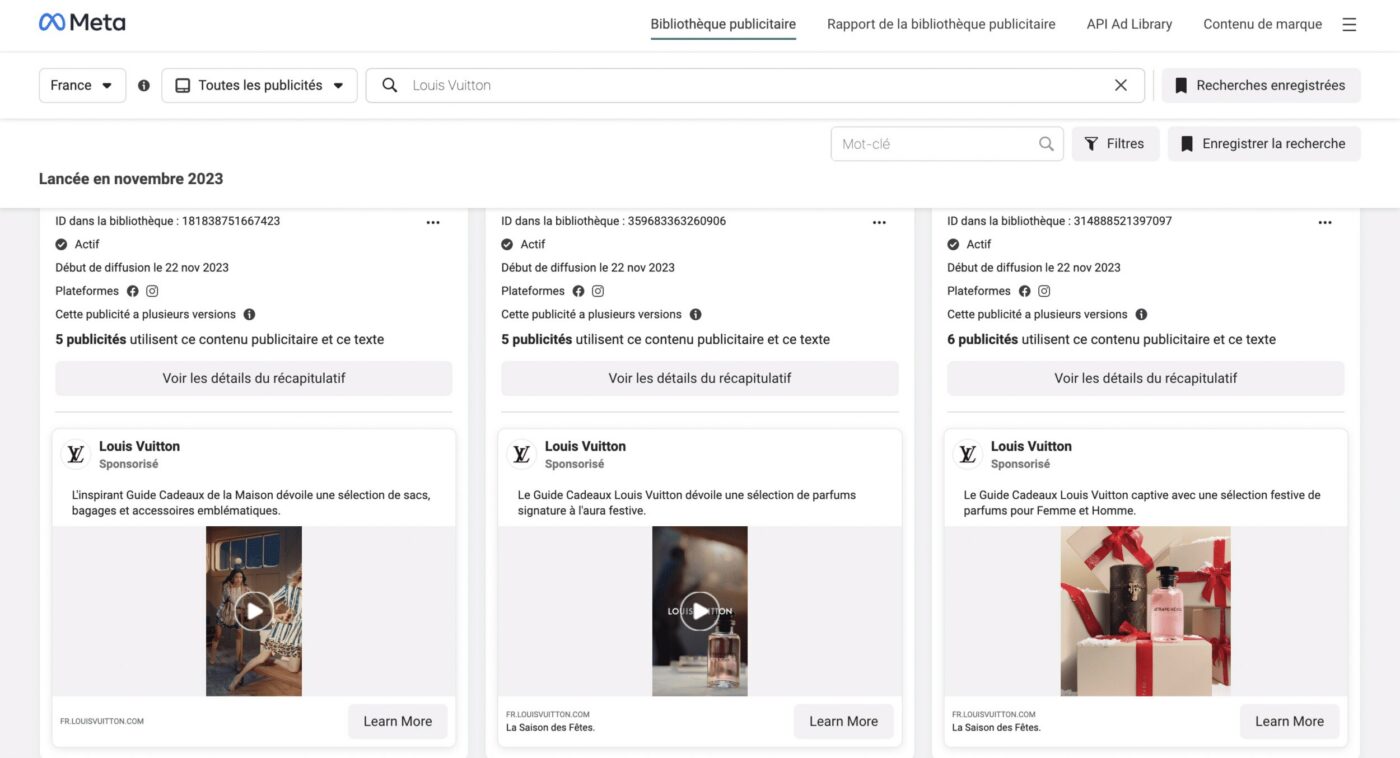
If you want to spy on the competition or get inspired by ads made abroad, here are three sites that may be useful.
They give an overview of the best work in your sector:
- The Facebook Ads Library, which gives you access to all advertisers’ ads
- Unicorn Ads, a site that lets you discover the top 1% of the best e-commerce ads by sector
- The AdCreativeBank, which also lets you analyze ads by sector, platform and seasonality
These tools are very handy for improving the performance of your campaigns by keeping you informed of advertising trends in your field.
Need a Facebook Ads agency to take your campaigns to new heights?
Neads supports you with certified experts in managing your campaigns and creating high-performing video ads.